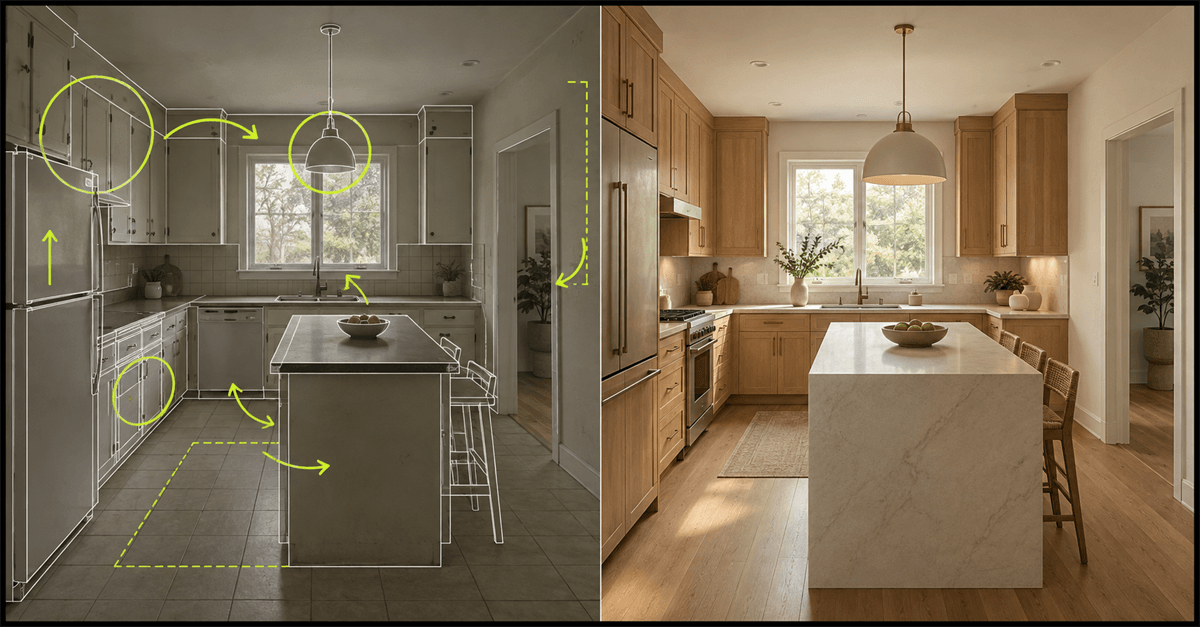
GPT-6 Astra can look at a photo of your kitchen and tell you what is in it. It cannot show you the kitchen with new cabinets. That one fact decides how to use it on a renovation, and most of the confusion about "rendering with Astra" comes from missing it.
What Astra is, in one paragraph
OpenAI released GPT-6 Astra to the public on September 4, 2026. Its model page lists text and images as input and text as the only output, and lists image generation as not supported. It holds about a million tokens of context, which is enough for a full set of plans, a spec sheet and a long conversation about them. In the API it costs $10 per million input tokens and $50 per million output tokens (model page checked October 2026). In short: a very strong reader and writer, not a painter.
What it is good for on a renovation
Treat it as the person who writes the brief, not the person who draws.
- Reading the room. Give it a photo and it can list what is there: the flooring, the window positions, the fixtures that would be expensive to move.
- Turning a vague wish into a brief. "Make it feel warmer" is not something any image model can act on. "Warm white walls, oak floor, brass fixtures, keep the window and the island where they are" is.
- Comparing options in words. Two flooring choices against your budget and the light in the room, or the trade-off between moving a wall and keeping it.
- Checking paperwork. A contractor's quote against the scope you agreed, or a materials list against the brief.
None of that needs a picture, and all of it makes the picture better when you get one.
What it cannot do
It cannot produce the image. Ask a text model for a render and the best it can do is describe one, or hand the job to a separate image model. On the API that hand-off is yours to make: the picture comes from one of OpenAI's image models, such as GPT Image 2.5, or from another vendor's.
That matters more than it sounds, because the hard part of a renovation render is not drawing a nice room. It is changing only what you asked for. A model that redraws your walls, moves a window or straightens a doorway has made a picture of a different house. OpenAI's own description of GPT Image 2.5 puts this first: it "modifies the requested element while leaving unrelated details more stable." That is the property you are shopping for.
A workflow that uses each model for what it does well
- Ask Astra (or any capable chat model) for the brief. Give it the photo and what you want. Ask for one paragraph that names what changes and, just as important, what must not: walls, windows, doors, ceiling height, camera position.
- Hand the photo and the brief to an image editing model. Not a model that generates from text alone. Editing models start from your photograph, which is what keeps the room recognizably yours.
- Check the result against the original. Lay them side by side and look at the fixed things first: window count, door positions, the line where the wall meets the ceiling. If any of those moved, run it again or narrow the brief.
- If the photo will be used to sell or rent the property, say it was altered. Several US states and the NAR Code of Ethics expect it. Our FAQ has the short version.
Where Astravisualize fits
We do step 2 and make step 3 easier. You upload the photo, type the change, and mark the area on the photo if words are not enough. The studio picks the right kind of edit, from staging an empty room to swapping a material, and keeps the architecture fixed by default.
You can choose the image model. Paid plans include OpenAI's GPT Image 2.5 in two versions: Flare, which takes about 20 seconds, and Sunburst, which takes about 30 and holds detail more tightly across repeated edits. Google's Nano Banana models are there too. Each render shows its credit cost before you run it. The first five renders are free with a watermark and use the standard model; plans start at $15 a month, and the pricing page has the details.
So the short answer: use Astra to think, and use an image model to see. They are good at different halves of the same job.
Astravisualize is an independent product and is not affiliated with or endorsed by OpenAI. GPT-6 Astra and GPT Image 2.5 are OpenAI models, named here to describe what they do. Model details are from OpenAI's published model pages as of October 2026 and may change.
- gpt-6-astra
- ai-rendering
- renovation
- image-models